
Have you ever met someone whose presence alone made a room feel calmer without them saying a word? Or left a conversation feeling drained, even though nothing was technically said or done to you?
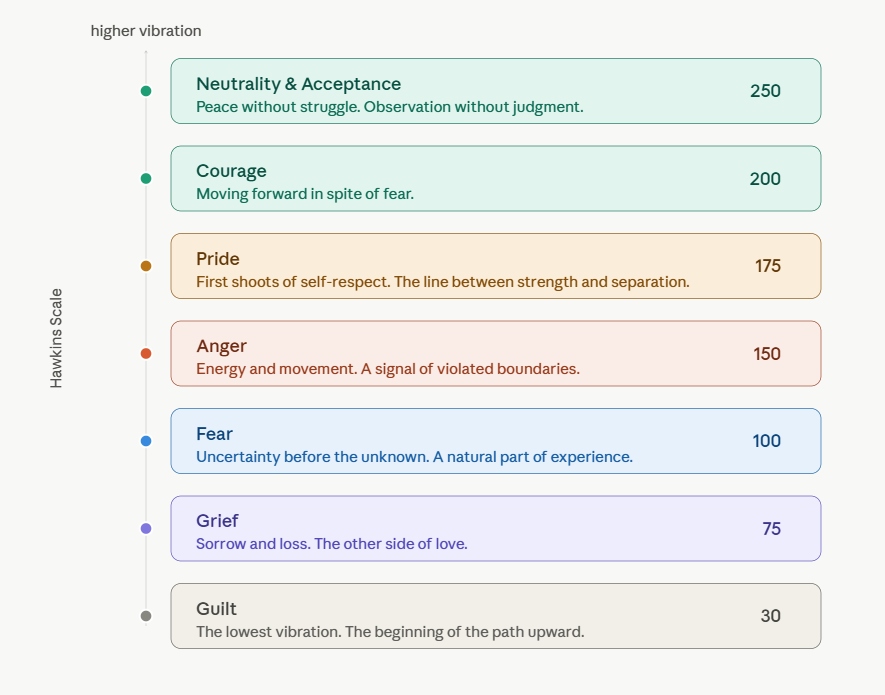
That’s not just personality. According to the Scale of Consciousness, developed by psychiatrist and researcher Dr. David R. Hawkins, every emotional and mental state carries its own energy and that energy is contagious, measurable, and mappable. Some states, like shame and guilt, sit at the bottom. Others, like courage, love, and peace, sit much higher. Most of us move through several of them before breakfast.
Here’s what’s actually useful to understand about it.
It’s a map, not a ladder
The scale runs from the lowest states: shame, guilt, apathy up through fear, anger, and pride, and eventually into courage, acceptance, love, and peace. It’s tempting to read this as a ladder you climb once and never come back down. In practice, it’s closer to weather. You might wake up steady and grounded, hit traffic and drop into frustration, get a good email and rise into pride, then feel a wave of grief in the evening for no obvious reason. The scale isn’t a report card. It’s a way of noticing where you actually are, moment to moment, instead of assuming you already know.
The turning point at 200
Hawkins placed a meaningful line at the level of courage (200). Below it, in fear, anger, and pride, our actions tend to come from self-protection, even when they look confident or even successful on the outside. Above it, starting with courage, we begin acting from genuine choice rather than survival. This is the difference between force and power: force pushes against something and eventually meets resistance; power moves with something and tends to build on itself. A lot of what feels like being “stuck” in life is really just operating from below that line for longer than we realize.
Awareness is the actual mechanism
Here’s the part that matters most for practice: you don’t move up the scale by trying to skip straight to peace, or by pretending you feel fine when you don’t. The shift happens the moment you can name what you’re actually feeling, clearly, and without judging yourself for feeling it. “I’m angry” or “I’m ashamed”, said honestly to yourself, is already a step up from being unconsciously run by anger or shame. This is where the scale meets something we talk about a lot on this site: the idea that consciously shifting your inner state changes what becomes available in your outer life. Observation isn’t a passive first step before the real work starts: it is the work, more often than not.
Higher isn’t “better”, it’s freer
It’s worth saying plainly: this isn’t about bypassing anger, or rushing grief, or performing positivity you don’t feel. Every state on the scale exists for a reason, and each one has something to teach if you let it. The goal isn’t to avoid the lower states, it’s to move through them consciously, rather than living unconsciously stuck in one of them for years at a time. A person who has genuinely processed their grief is in a very different place than a person who has simply suppressed it, even if both look “fine” from the outside.
Where to go from here
Reading about the scale is one thing. Actually moving through it, feeling what guilt has to teach you, letting anger point you toward your real boundaries, finding your way to genuine acceptance, is another. That’s exactly what our seven-part meditation series was built for: one guided practice for each state, from guilt all the way to neutrality.
→ Begin the 7-part journey through the Scale of Consciousness
This article is inspired by the Scale of Consciousness developed by Dr. David R. Hawkins. It’s intended for personal reflection and spiritual exploration, and isn’t a substitute for psychological or medical care.
Thank you for reading,